I recently wrote this article for Carleton University's TA Talk newsletter as part of the requirements for a Certificate in Teaching Skills. I wanted to give some ideas for computer science TA's on how they might take advantage of the workshops offered at Carleton, since many of them figure the workshops are not designed for our discipline. There might be similar training opportunities at your school, so have a look and take advantage!
Useful Workshops for Computer Science TA's
On more than one occasion, I've heard computer science teaching assistants mention that there weren't any TA workshops geared toward them. Many were most useful for business and arts programs, they said, since we don't have discussion groups or mark essays. Even the lab speed grading workshop didn't really apply to us, since marking scientific lab reports are very different from marking computer programs.
After completing 14 hours of workshop training for the Certificate in Teaching Skills, I can honestly say that I found something useful in each and every workshop I took. I'd like to share some ideas of how you might be able to apply the concepts you learn at these training sessions.
In Soliciting Useful Feedback From Students, you can think about how you might start a feedback loop between you and your students. This is probably most useful if you are leading tutorials and want to get an idea of how effective your teaching style is, but you can even get feedback on your office hours and marking abilities.
Teaching Millennial Students is a bit of an eye-opener, especially when you see some of yourself in the description of 'kids these days'. It really helps prepare you for the kinds of things students might expect of you, and where you can draw the line. For instance, did you know that some students' parents actually contact TA's directly? It's rare, but it's good to be prepared for such a situation!
Any workshop that talks about technology will have concepts that work very well with computer science students. Having a course blog or online office hours, for example, might be the perfect way to engage the many students who never come to visit your office hours in person.
Finally, even though discussion groups are rare in computer science, the techniques used in them can be very applicable to how you run tutorials or office hours. You can learn about various activities that allow you to avoid speaking up at the chalkboard each and every tutorial. For example, I've used some of the techniques for a first year game development class, giving students a break from the usual exercises at the computer.
These are just some brief ideas on how to make the best of your training as a computer science TA. Give it a try, and with the right perspective going in, you'll be sure to find some of your own.

Sunday, May 3, 2009

Tuesday, April 28, 2009
Let's Talk Chemistry!
I finally got to do a really, really cool Let's Talk Science activity at my old high school with my partners Zahra and Carolyne. It was a chemistry magic show, where we played with everything from slime to fire to liquid nitrogen. Oh yes, and we taught them some chemistry on the way.
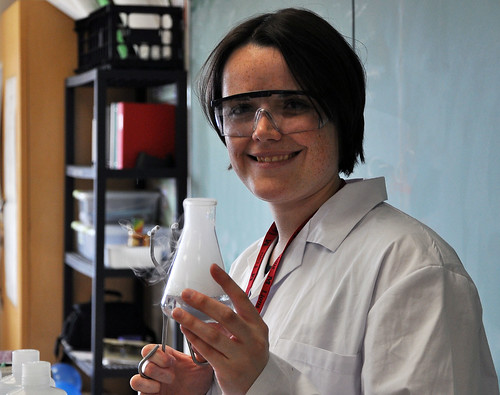
Here's me in 'mad scientist' mode, posing with the Evil Scientist Brew made with dish soap, sodium hydroxide, universal indicator, and dry ice. The dry ice creates the 'smoke' and acidifies the solution, eventually changing its colour.

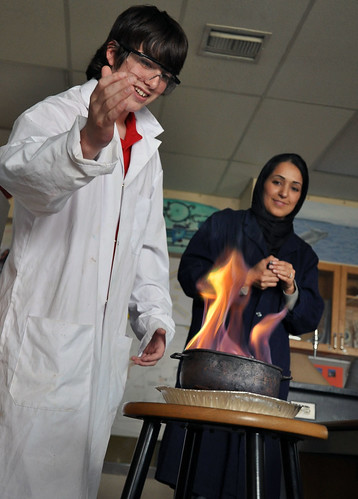
The fire comes after playing a trick on one poor, unsuspecting student. We asked him to mix together two solutions for us into a homogeneous solution. Much to his dismay, though, a solid is created! We ask him to fix his 'mistake' by burning (and thus melting) it, but it turns out that doesn't work either because what we've actually made it Sterno.
So once we have our fire going, we throw in various metals to get pretty colours.
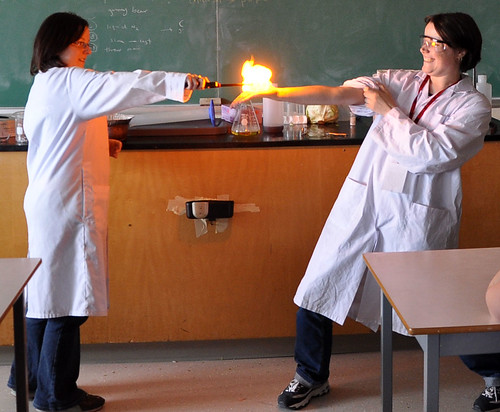
I had a lot of fun demonstrating the fast burning nature of gun cotton...
...and the students loved our elephant's toothpaste...
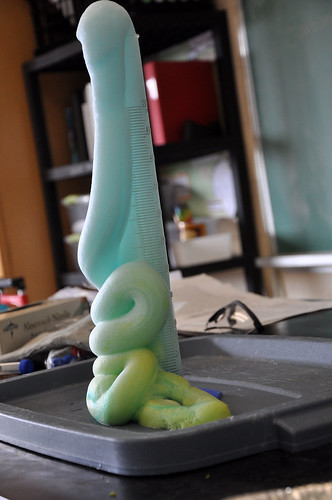
...making slime...
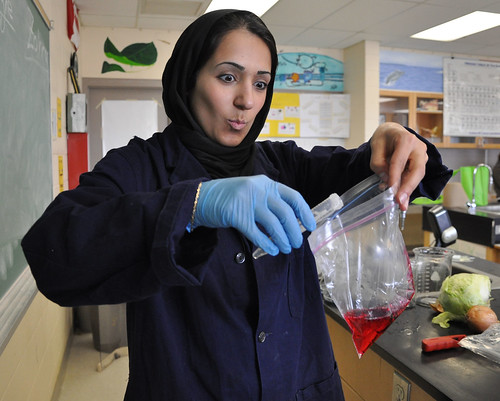

There are many more photos of these 'experiments' and others (like 'death to the gummy bear') available on my Chemistry Magic Show Flickr set (all photos that I'm not in were taken by me).
While this isn't exactly computer science outreach, it does show how much fun outreach can be!
Here's me in 'mad scientist' mode, posing with the Evil Scientist Brew made with dish soap, sodium hydroxide, universal indicator, and dry ice. The dry ice creates the 'smoke' and acidifies the solution, eventually changing its colour.
The fire comes after playing a trick on one poor, unsuspecting student. We asked him to mix together two solutions for us into a homogeneous solution. Much to his dismay, though, a solid is created! We ask him to fix his 'mistake' by burning (and thus melting) it, but it turns out that doesn't work either because what we've actually made it Sterno.
So once we have our fire going, we throw in various metals to get pretty colours.
I had a lot of fun demonstrating the fast burning nature of gun cotton...
...and the students loved our elephant's toothpaste...
...making slime...
... and playing with liquid nitrogen!
There are many more photos of these 'experiments' and others (like 'death to the gummy bear') available on my Chemistry Magic Show Flickr set (all photos that I'm not in were taken by me).
While this isn't exactly computer science outreach, it does show how much fun outreach can be!
Sunday, April 26, 2009
CRA-W Grad Cohort: Balancing Graduate School and Life
Balancing school with life. This is a topic that comes up all the time for women in science and engineering - it seems to be something we all struggle with. I guess that's why it was the focus of one of the last keynote talks at the CRA-W Grad Cohort. Here's my summary of the useful advice given to us by two wonderful women with different ways of working toward that seemingly elusive balance we all seek.
The first suggestion is to prioritize your work and your responsibilities. If you have to work to earn a living while going for your PhD part time, for example, you should never let school get in the way of your employment! Having said that, it doesn't hurt to work harder than you have ever worked before, because it won't last forever and it will be so worth it.
You should try to set yourself short, deliverable goals. I've learned that this isn't easy from own experience - I wanted to make milestones during my Masters, but never nailed them down. It can sometimes help to ask yourself not just what your goals are, but why you have them. Did you set your goals for yourself? Or do you just want others to think highly of you? This might help evaluate the priority of each goal. Also remember to celebrate when you achieve any goal, big or small, be it a dinner out or a few hours of soaps.
Don't be afraid to ask questions when it gets hard (you'll be worse off not having a good answer, even if you embarass yourself asking). Find mentors among your colleagues and friends, since you might feel more comfortable asking them for help. And try not to panic - there is always a solution!
An interesting idea is to sign a contract with your significant other, should you have one, before you get going on your Masters or PhD. This way they know what to expect and how hard things will be. You may also agree on what kind of chores or childcare duties will become very hard for you to take care of, and what things you promise to try to do.
Remember that nobody can maintain an insane pace forever. Sure, we can do it in bursts, but we need breaks, or else we'll burn out! I always tell new students to make sure they take breaks to go for a walk, talk with friends, hang out outside... anything to get your eyes off a screen. It can be really hard to shake the guilt that you aren't working on your research, but let's face it - the time spent recharging your mind will be paid back tenfold in the newfound productivity when you get back to work.
We all have insecurities, and the darned things can really get in the way of accomplishing our goals! The best thing to do is be honest with yourself so you can move past them. Setting up a positive feedback file, where you keep all the nice notes and emails people have sent you over the years, can give you a happy place to spend a few minutes when you're feeling down.
A few parting tips given to us:
- Remember to schedule in play time.
- Remember to take care of yourself (exercise, sleep well, eat well).
- Apply extra money to buy housekeeping, babysitting, etc if possible.
- Maintain your friendships and don't isolate yourself!
- Getting a PhD is work - but you have to work on your life too!
Wednesday, April 22, 2009
MangoBunnies in Imagine Cup Finals
Many attendees of the Grace Hopper Celebration of Women in Computing had the pleasure of meeting Ed and Ashley. They were volunteer videographers and captured highlights of the entire conference, including hellos from organizers, volunteers, and delegates like me! One of the videos that I ended up being in along with my CU-WISE colleagues appears on this post I wrote about networking.
This dynamic duo entered into Microsoft's Imagine Cup competition with their colleague Malisa, giving themselves the fun team name of MangoBunnies. They've made it to the finals, and have a really good chance of taking the peoples' choice award! But they need people like you to vote for them.
This is especially exciting since it's the first all-women's team to make the finals in the US, according Mary-Jo Foley of Microsoft. Congrats ladies!
Wednesday, April 15, 2009
CRA-W Grad Cohort: Being a Woman in Technology
One of the keynote talks at the CRA-W Grad Cohort was a little more female-specific than some of the others. It discussed some delicate situations that often arise more often among women in computing than men. It struck just the right balance between humour and frank seriousness, making it informative and enjoyable. Here are some of my favourite scenarios brought up...
The first situation involves the men in your research group belittling you, interrupting you, and so on; all the while, the supervisor is oblivious to the problem. Some of the more obvious advice includes "putting it on paper" so you can bring concrete examples to those in charge later on, and learning to be strong enough to support and argue for your ideas without getting emotional. I personally rather enjoyed the demonstration given by a very strong (what a firecracker!) woman on the panel, in which she glares at the interrupter and says very concretely, "Let me finish." Apparently they stop interrupting after hearing that a few times! Similarly, if your ideas are being poached by the others, you can regain credit by saying something like, "Oh! I'm so glad you agree with me," or, "Wow, you definitely articulated that idea better than me - thanks for that."
Another interesting scenario occurs when the guys go out to, say, the bars (where they may want to check out the women) and don't want to invite you. I haven't encountered this myself; my lab is awesome about having lunches or a Friday beer to which everyone is openly invited. I end up not going that often because I find myself way too busy, but that's my own doing, not the guys in the group! But if you do find yourself in this situation, sometimes just pointing it out is enough to get invited the next time. Just be careful what you wish for - if you ask for something, you'd better darn well follow through and go, even if it means heading to a crowded bar! You can also do your homework, learning about whatever it is that interests the guys and that they assume doesn't interest you. If all else fails, just make your own plans, and then invite them to come!
If you're faced with the assumption that women always organize the non-work events (social events and such), and you don't really want to be in charge every single time, the best thing to do is learn to say no. I know, it can be really hard to do - sometimes these things are just plain fun. You can accept these requests a couple of times to at least prove that you are indeed good at organizing, but do not accept every time, even if you like doing it! There are many other things you need to take care of! A good trick is to invite others to help you out, in effect teaching them how to run these events the next time (without you, of course).
Finally, my favourite: What do you do if you're attracted to your adviser? Don't do it! Apparently it's the "kiss of death for your career!" Granted, if played in exactly the right way (including switching supervisors - maybe even schools - and keeping it a secret until the defence is done), it might work, but really - if it was meant to be, surely it can wait until you graduate? (I'm sure this is easy to say when not in the situation, but if you ever find yourself there, remember that this advice is coming from some very knowledgeable and successful women.)
There were a few more scenarios discussed than I wrote about here. Some are included in this fellow conference-goer's blog post about this talk. If you have a few of your own, share in the comments!
Subscribe to:
Posts (Atom)