Monday, July 30, 2012

Register now for the Grace Hopper Celebration of Women in Computing!

I'm really excited to be attending this year's Grace Hopper Celebration of Women in Computing in Baltimore, and I hope you'll consider going, too! Tomorrow is the last day for early bird prices, so register now!


This year is a particularly special year for me.  I've been hoping to get my husband to Grace Hopper for a while, but it's never quite worked out.  I really want him to get a glimpse into my world of 'women in tech' since I do so much work in the area (outreach, trying to improve curriculum, and so on).  I imagine he'll have lots of useful insight and information to bring back to his workplace.  I also think he'll really enjoy the technical talks.

Since this year's conference is just nine hours from home, we're planning on driving there.  Not only that, but we're hoping to bring our daughter, who will be 9.5 months old at the time.  Being able to introduce both of them to all the amazing technical women I now call friends thrills me to no end.

I'm also going to be one of the co-chairs for the Communities Committee this conference, so it's shaping up to be my best year yet!

Whatever your reasons for attending (and there are many!), I hope to see you there.  Remember: early bird registration ends tomorrow (July 31)!

Wednesday, July 25, 2012

Playable Quests

Quests in video games are a nice way to give players choices to make and offer a story line that seems a bit less linear.  Have you noticed, though, that most quests seem to follow the same pattern? Usually, they're all about picking up a certain number of items or killing a certain number of enemies.  They tend to be a list of tasks to complete rather than offering an overall goal that could met in a variety of ways.

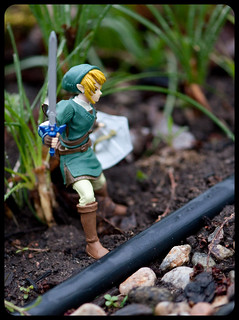
Link's Adventures
Link's Adventures / Gail-Carmichael

Anne Sullivan, a recent Ph.D. graduate from UC Santa Cruz, spent at least some of her years as a grad student working toward making quests more interesting.  She calls goal-based quests playable because they offer players meaningful choices in terms of how the quests are completed.

In her framework, Anne focuses on the use of social (as opposed to attack-based) mechanics.  Players are able to complete social-oriented quests that are dynamically selected by the framework.  What quests are available is partially based on what plot points in the overall game narrative the player has seen so far.  The quests are goal based, so players can decide for themselves how they would like to complete them.

For example, if the quest involves breaking up a dating couple, the player might be able to get one person to distrust the other, or start dating one him or herself.  Or, he/she might even cause the opposite to happen and encourage the couple to elope! The overall game story may change based on what the player chooses to do — something you rarely see happen with quests these days!

I really like this concept, not only for the new type of social mechanics (fighting gets old for me), but because the quests actually affect the rest of the game's story.  This does occur in small ways now, but the main plot points hardly change if ever.

I also noticed in Anne's publications some similarities between what I read way back when in Chris Crawford's book on interactive storytelling and the structures used to capture the social mechanics in her own framework.  I didn't follow the citations back to see if the framework (and what it was built on) was directly inspired by Crawford, but it does make me a little bit happy to potentially see Crawford's work becoming useful considering this sad article about him.

I am likely to do work in the area of quests and non-linear story, so hopefully I'll also be able to help make a difference in the quest to make stories more playable!

Friday, July 20, 2012

Point-and-Shoot Game Creation

Were you ever the type to pick up a newspaper just so you could complete the crossword puzzle? Apparently this was a point of entry into the paper for many people, but the concept didn't get translated very well when journalism went digital.  In his Games for Change Festival talk Ian Bogost suggests that newsgames might be a new way to draw people in.


But here's the problem: making games is kind of hard. And newsgames — “any application of journalism in video game form” — have to be made quickly so they are relevant to current events.  Should we start training journalists in computer programming? That might be useful, but it's not a short term solution.

Instead, Bogost has created Game-O-Matic, a tool that can quickly create simply microgames based on a concept map anyone can put together.  This allows journalists to work at the ideation level.  It's kind of like being able to take a snapshot of the world with a point-and-shoot camera; it's a point-and-shoot game maker.

The concept is really interesting because it distills games down to their most basic pieces.  If the idea ends up working well, I could see it going much further with story generation based on concept maps.  If nothing else, it could be quite useful as a brainstorming tool.

Monday, July 16, 2012

No Screen Time Under Two

We've got two computer scientists in our three-person family.  Would it surprise you that our daughter, currently seven months old, is not allowed to watch any TV, videos or games, and does not play with our iPhones at all?


Yup, that's right. We're actually trying to follow the 'no screen time before 2' advice.

Before I go any further, I would like to emphasize that I am not judging any family that allows their babies to watch TV (or play games, or whatever) for any length of time.  This post is about exploring our attempt at avoiding it because doing so felt right for us.  I know there are many who find screen time tremendously helpful and/or educational!

This PBS article does a good job of summarizing the research related to television and children under 3.  It starts with some startling statistics that show how many infants and toddlers are exposed to television despite warnings against it (I haven't found anyone I know that is doing what we are).  But it then points out that there has been surprisingly little research done into the actual effects of TV.  Unsurprisingly, research does show that the role of a caregiver in watching programs is even more important than the content itself.

The American Academy of Pediatrics (AAP) released a statement in 1999 that included this:
Pediatricians should urge parents to avoid television viewing for children under the age of 2 years. Although certain television programs may be promoted to this age group, research on early brain development shows that babies and toddlers have a critical need for direct interactions with parents and other significant care givers (eg, child care providers) for healthy brain growth and the development of appropriate social, emotional, and cognitive skills. Therefore, exposing such young children to television programs should be discouraged.
In 2011, the AAP released a more modern statement.  As discussed in The New York Times:
The recommendation, announced at the group’s annual convention in Boston, is less stringent than its first such warning, in 1999, which called on parents of young children to all but ban television watching for children under 2 and to fill out a “media history” for doctor’s office visits. But it also makes clear that there is no such thing as an educational program for such young children, and that leaving the TV on as background noise, as many households do, distracts both children and adults.
Interestingly, the less strict recommendations were made because many people thought the all-out ban was all but impossible to follow:
The recommendations are an attempt to be more realistic, given that, between TVs, computers, iPads and smartphones, households may have 10 or more screens. 
We have multiple devices in our house (though probably not 10), but we have an advantage.  We don't watch TV, and though we really enjoy playing games and watching movies, we don't have much opportunity for it these days.  Thus, for us, an all-out ban is feasible.

And that's what we're going for: an all-out ban on screen time.  My only exception is that I don't mind if she sees me browsing or emailing, so long as there are no videos on the screen.  Our choice is validated anytime she does see a video accidentally: she turns into a zombie and just stares at it.  If a TV is on nearby, you can hardly stop her from turning her head around toward it.  That makes me uncomfortable.

I'm not sure if we'll last all the way until 2, but we'll do our best.  And when the time comes, I have to admit that I am very much looking forward to playing some fun kid-friendly Kinect games.

Thursday, July 12, 2012

Stanford Student's PhD Memoir Worth Reading

Philip Guo's Ph.D. Memoirs have spread like wildfire, and for good reason.  His well written short book offers a fascinating look into life as a grad student at Stanford while offering some really valuable advice for those of us still in the trenches.

Con-grad-ulations!
Con-grad-ulations! / marceloilers

Guo describes how he started his PhD years grinding on his supervisor's project with little benefit in terms of research outcomes that could contribute to his thesis.  Internships helped him recover from burn-out, gave him some research inspiration, and provided valuable contacts.

In the latter years, he decided to define his own project. Though not his main interest, Guo's supervisor was supportive of the idea.  Guo was also able to find other academics whose interests and obligations aligned with his project, helping ensure success.  He graduated after six years and is now working for Google.

I really enjoyed reading this because it helps to know that even students of this calibre struggle.  One of the key takeaways for me was to make sure I align myself with my professor's needs.  For instance, he needs a student to be part of a particular story-related project for a research network he's part of, so I should try to make my own project fit into that framework.  Another useful tip was to work with the insiders of a particular sub-field to make your chances of getting into top-tier conferences higher; the insiders know what reviewers want and can pitch the research appropriately.

I highly recommend you read this memoir if you are a grad student or thinking of becoming one.  But if you're short on time, look at the twenty most memorable lessons in the epilogue.  I'd love to hear which tips resonate most with you.