Thursday, October 27, 2011

Help Wanted: Examples of Nonlinear Stories and Less Successful AR Projects

I'm working on two projects where I need to come up with as long a list of examples as I can.  I've got some in mind, but what better way to make sure I don't miss the important ones than to ask all of you for your ideas? I hope you'll share your thoughts. Yay, crowd sourcing! :)

Crowd Sourcing 

 
Nonlinear Stories in Traditional Media

The first set of examples I'm working on is a list of movies and books that have nonlinear plots.  I'm not necessarily talking about interactive stories here; instead, I want to know about any story that presents itself in a non-chronological order of some kind.  For instance, the plot in Memento is shown in reverse order, and events are told by various narrators in Hero.

In addition to the actual example, it would be great to hear your thoughts on how the creators have explained the use of a nonlinear plot in the context of their stories, or what technique they used to present it.  In Memento, the backwards plot fits in with the brain damage of the main character, and in Hero the technique is the use of different framing devices (in this case, an unreliable narrator).

This list is going to be used in thinking about nonlinear narrative in games.  I will let you know more closer to the end of the term.

Less Successful Augmented Reality Projects

Do you know of an augmented reality project from academia or industry that seemed really good but never really caught on to be a big success? Or a project that wasn't actually very good in the first place? This includes projects that have been important in terms of the technology they have moved forward, but that didn't seem to have a lasting use to real people, as well as commercial flops.

I'm going to be using these examples in a discussion of how less successful augmented reality projects could be improved.  It's related to my work on using cognitive theories to uncover the value of AR.  The current version of our paper is probably going to a journal or magazine, and I am very much looking forward to sharing it with you all - hopefully soon!

Monday, October 24, 2011

Computer Science is Everywhere! (Even Photography)

Last week I did a couple of workshops at the Canadian Museum of Science and Technology for National Science and Technology Week.  I managed to improve the usual 'computer science connects to everything' theme to be more interactive, and judging by the apparent engagement of the students, it was a success.  Below is an outline of what I presented - feel free to adapt it for your own presentation (with some credit to me if you don't mind).
I'm here from Carleton University to tell you about one of the biggest reasons that I love computer science: it connects to everything! No matter what your interests are, or your passions, there is a problem waiting to be solved and a way to make life easier or better with computing.  Even something as creative as photography has a lot to do with computer science, as we'll see later.
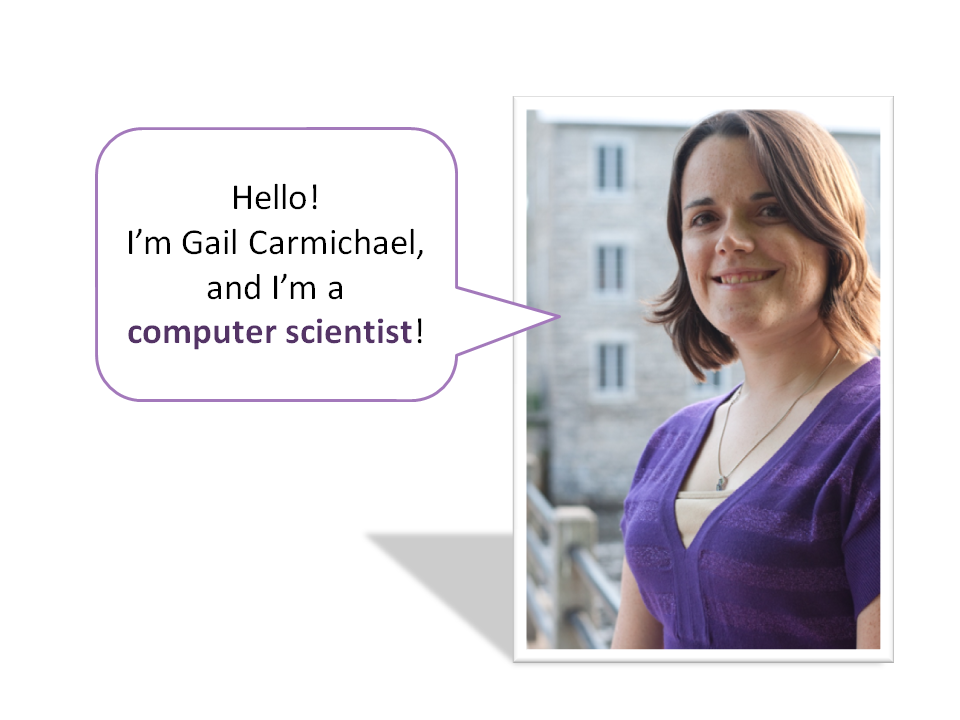
My name is Gail Carmichael, and I'm a computer scientist. Of course, that's not all I am.  I'm also a PhD student (which means I've been in school for almost ten years since high school!). I do Taekwondo (anyone else into martial arts?) and like to go backpack hiking and work on my garden.  And, as you can see, I'm also going to be a mom soon!

(I always make an effort to show the students that just because you are into computers doesn't mean you can't also be into lots of other fun things as well.  This time I was also able to talk about becoming a mom, which I think it really important for both the males and females to see.  In fact, one of the boys came up to me after the workshop to wish me luck with the baby - how awesome is that??)

I'm also part of a group at Carleton called Women in Science and Engineering.  In fact, I helped start this group a few years ago.  I don't know if you all know, but we still have far too few women in computer science, and we want to fix that.  So, ladies in the audience, I encourage you to look into computer science as a possible career if you see anything today that interests you! (Guys, too - we want all the smart people!)

Ok, so let's talk about computer science.  Anyone have any ideas of what computer science might be? Or maybe what kinds of things computer scientists do?

(You usually get answers more related to using computers, but you can also often get some good insight into what the field's really about.)

I'll tell you exactly was computer science is about in one second.  But first, I want you to all take a minute to brainstorm as long a list as you can of areas of your life where computing is involved.  Think of the obvious, like cell phones, to the less obvious, like toasters (yup, even your toaster might have a little computer inside!).


Here are some of the areas I thought of.  Some of these are more obvious, like the iPhone and video games.  What about some of the others?

(I find the students love giving more ideas on these topics or asking questions about them.  Invite interaction here as much as possible.)
  • Music: You could write software that analyzes music and automatically creates a playing list that would suit our current mood.  Or you can try to teach the computer how to create good music from scratch.
  • Medicine: You can use computers to simulate chemical reactions and help us narrow down what sorts of things might be effective in treating particular illnesses.  You can also use computers to crunch the huge amounts of data in our DNA, helping us find genetic issues in a person.  (Bet you didn't think you'd be able to save lives as a computer scientist, did you?)
  • Video Games: Sometimes we want to provide good entertainment as computer scientists, and making games is one way to do this.  You can even study game development as a whole concentration in our computer science program at Carleton!
  • Geography: When's the last time you used Google Maps or a GPS device? There's a lot of computer science happening there, such as when you are finding the most efficient route to your destination.
  • Psychology: If you're interested in the way people think, you can help design technology that makes sense to humans.
  • Math: Computer science can be a very mathematical way of thinking.  (But don't worry, you don't have to be a math whiz to do well in this field!)
  • Robotics: We have to program robots to get around without running into things and much more.
  • Education: I want to make games that are both fun and educational.  School looks very similar to what our great-great-grandparents experienced, but I think that technology can help change that and make learning more fun and effective!

In the end, computer science is really all about solving problems.  It's not about programming or software or any of that stuff on its own - these are all just means to the end of making the world better.

(Try to relate the students' answers from earlier into the above discussion.)

What problems are there to solve in photography? How can we improve such a creative practice with technology?
Some of you might remember taking photos with film before digital cameras became standard. Film worked by having an actual chemical reaction to the light that hits it.  How do we take a picture digitally?

(If there's time, it's fun to get them guessing how we get from a scene in the world to an image on the computer.)

Instead of using chemicals that react to light, we can create what's called a digital sensor that can sense what light is hitting it.  But how does this translate into what the computer can understand?

Do you know how data on your computer is stored? What everything ends up being in the end? (Answer: numbers! Binary numbers in particular.) Even an image is going to end up as numbers.  So we need to translate the light hitting the sensor into numbers somehow.
Let's say I took this photo with my digital camera and I'm looking at it on the computer.  What happens if I zoom in really close? (Answer: it gets pixelated, blocky, blurry, etc.)

Our digital sensors are made of grids of pixels as well, and each of these pixels captures the amount of light that hits it.  Then we can store this as a number for each pixel on the computer, representing the image.


(At this point, I use images from the CS Unplugged Image Representation activity to demonstrate how this can work with black and white images, and I give them some time to try recreating the pictures on the handout on pg 4 of the PDF.  We discuss the pros and cons of the two ways of representing the image - each pixel as its own number or writing out the number of black or white pixels that come in a row - and I emphasize that we often have to consider tradeoffs when solving problems in computer science.)

To conclude, let me say again that computer science is everywhere.  In photography, there are many more problems that computer science helps solve, from organizing and searching through our photos to applying interesting effects to them.  Computing touches every part of our lives, from keeping us healthy to keeping us entertained.

Wednesday, October 19, 2011

What if you want a PhD but don't plan to do research after?

I was thinking the other day about the different reasons a person might want to get a PhD, and I wondered if those who weren't necessarily intending to be researchers when they were done would be valued as highly during their grad school years as those who did.

Academic 

I suppose the most common reason to get a PhD is because you want to do research, either as a professor in an academic setting or at a research lab (industry or otherwise).  After all, this is what the actual PhD work teaches you more than anything else: how to do research.  Sure, there are opportunities to improve and practice your teaching as well, but it's certainly not required.  Some people don't even want to be TA's because of the time it takes away from their main task.

But is it not also perfectly legitimate to get a PhD because you simply want to learn more about something? To have the opportunity for academic and other experiences that you'd never have otherwise? Or maybe you want to work on a particular problem not because you love the world of research in and of itself, but because that problem is something you are passionate about solving.

Perhaps you want to just teach when you are done.  Sure, you might not need more than a Masters to do that in a university setting, but the reasons above may be enough to take it that step further.  Or maybe you want to continue working on solving that problem you started working on as a business venture or within another company.  Maybe you see the solution as something that can make the world a better place.

Are students whose primary post-grad goals do not include research less valued during their PhD, assuming they have fairly good (but not top) research ability combined with other excellent qualities (such as leadership, etc)? Do they get less scholarships and recognition? Do they suffer more because of the Publish or Perish mantra?

I don't know the answers, but while I would like to think this wouldn't be the case I suspect that it could easily be.  Does it matter? What are your thoughts?

Friday, October 14, 2011

'Publish or Perish' Should Perish

I hate the 'publish or perish' mantra of academia.  I really do.  To me, it takes the focus away from doing great work and waiting until it's truly ready for public consumption and instead stresses us out as we try to ensure our publication record is up to snuff.

P is for Produce, "Piled Higher and Deeper" by Jorge Cham www.phdcomics.com

I particularly dislike the mantra these days because it's so easy to document what we're up to online.  If committees for scholarships, tenure, etc want to see whether we are doing good research, they could in theory find out in other ways, for example from our discussions, blogs, websites, and more online (assuming of course that we researchers got better at taking advantage of such media).  The full process, including the failures, could be captured.  Granted, it's not as official as a peer reviewed paper and false information could be spread, but in some ways it's a more full and genuine glimpse into someone's research ability, while the published papers come to represent the most polished work possible.  Perhaps if we wanted this to become a standard, we could find ways to ensure the information available outside of published work is useful and trustworthy.

I certainly hear of many others who dislike the current way of things as well.  But, as they point out, it's the way you have to play the game in academia.  True, but is generating knowledge for the purpose of playing the game really going to result in the best outcome? And is the length of someone's publication list really a good indication of the value they are bringing to the world?

I'd love to see a fundamental shift in our thinking when it comes to publishing.  I do believe that the process of peer review and the ability to share the outcome of our research is important, but I wish the emphasis was more on high quality results than the insatiable need to just get something out there.

Do you feel the same way? How would you change the system if you could change anything?

Wednesday, October 12, 2011

Research Plan: The Role of Story in Educational Games

I've (finally!) been working on a concrete thesis research plan and wanted to share a general idea of what I'm intending to do.  The short version is that I want to experimentally determine how different types of stories actually affect learning outcome in educational games, and make it easier for others to incorporate story into future games.

Stray Souls Dollhouse Story game screenshot  


These are the main questions I'm hoping to answer in three phases:
  1. As shown through experimentation, does the use of story in educational games offer
    players an opportunity for deep learning beyond simply providing motivation or engagement?
     
  2. Does the use of nonlinear narrative or interactive storytelling improve engagement and/or learning?
     
  3. How can narrative best be incorporated into educational games? What set of metrics could
    be developed to help game designers ensure that they are able to effectively tie together their story, educational content, and gameplay mechanics?
     
  4. Using this knowledge, what would a tool to support the authoring of stories for educational games look like?
The idea is to first choose a set of games with which to conduct experiments that test learning outcome.  Some of these games will be already established works with clear learning objectives and stories that can be removed without severely affecting the educational content. We will also use some of our own designs.  The selection of games will be made with the second research question in mind; that is, we wish to find games that use both linear and nonlinear storytelling techniques.  The results of these experiments will heavily influence the rest of the research.

In the second phase the set of metrics mentioned in the third research question will be developed.  Established games and games of our own design will be used to iterate on the metrics until a reasonable set can be settled on.

Finally, the third phase involves writing a tool that will both help enhance an author's creativity when writing stories for educational games and help ensure the story is consistent with the educational content.  How it will look depends, of course, on the results of the first two phases, but I am imagining using some AI techniques to help check consistency and make story suggestions.  There may also be an opportunity to use some graph analysis, for example to take advantage of connections between content topics present on sites like Wikipedia.

One of the coolest things that's happening with respect to this plan is hearing excitement from writers who want to be able to write better interactive stories for educational games.  I'm thrilled to have people I can speak with directly to ensure that what I do ends up being useful, and I may even have some professional writing help when designing our own games for our experiments.  Hopefully it'll be win-win for all of us!

Did reading this raise any red flags to you? Do you have any ideas or suggestions? Please leave a comment and let me know! The more feedback, the better.