Showing posts with label GHC12. Show all posts

Sunday, October 7, 2012

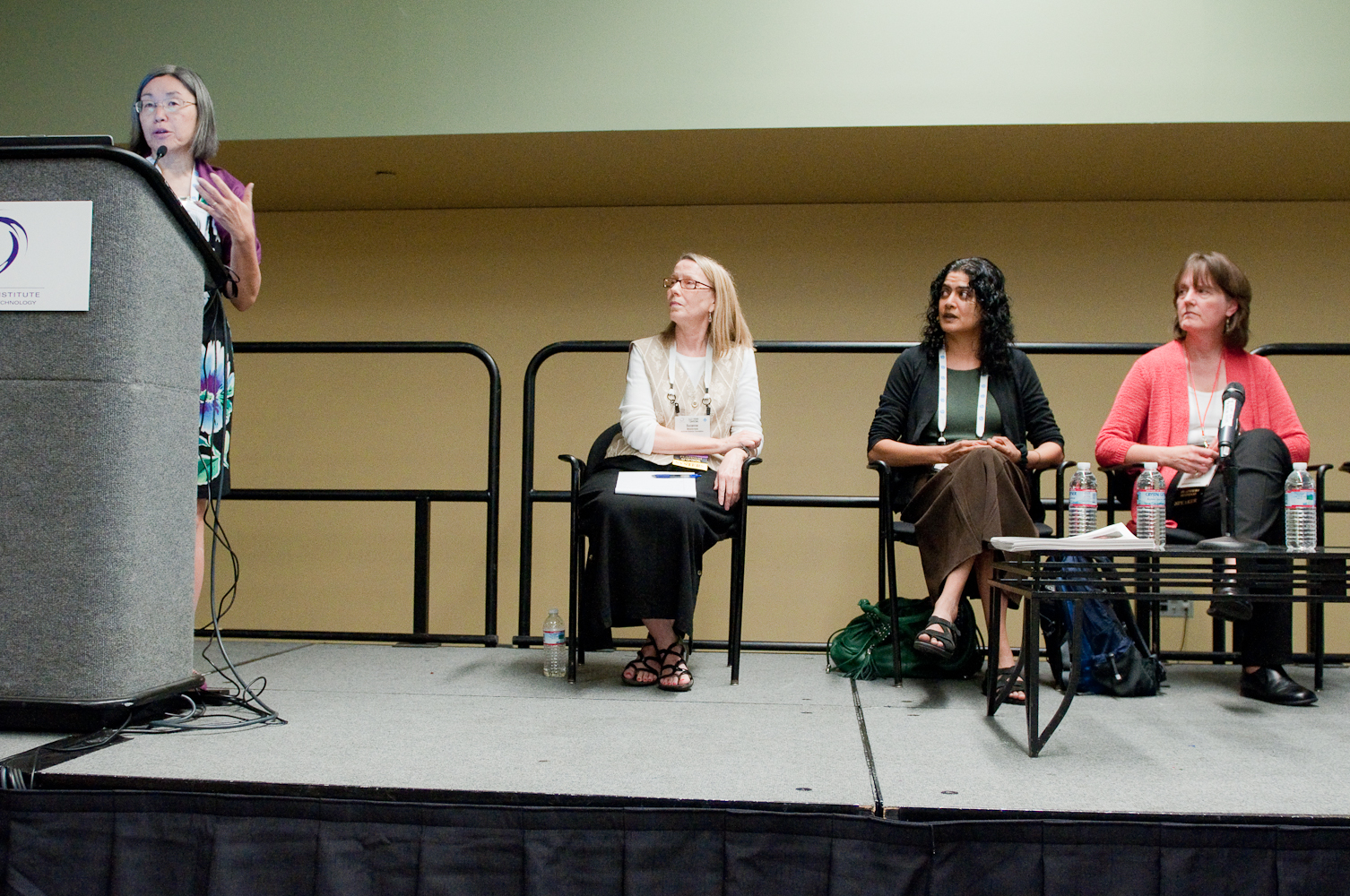
NSF Funding Opportunities and Effective Proposal Writing Strategies (GHC12)

Even though I'm a Canadian grad student, the Grace Hopper session on National Science Foundation (NSF) opportunities was very relevant to me.  As my collaborators and I try to put together a team and plan for my Gram's House project, we are looking toward putting in a grant application.  So at this talk, I was looking for inside tips from the panellists representing NSF that might help increase our chances of success.


The presentation gave a good overview of the various programs available from NSF, but rather than reiterate those here, I encourage you to look at the funding portion of NSF's website.  The program I am most interested in was Computing Education for the 21st Century since I thought that would be the best fit for Gram's House.

One interesting statistic on the applications for NSF grants: the percentage of women applying tends to be low, but the acceptance rate of men and women according to how many applied is more or less equal.  Turns out this is because when women are rejected, they often stop there.  But when men are rejected, they get mad, and try again. And again. However many times it takes.  I'll have to keep this in mind as we try to move our project forward.

As for strategies for success, it's important to remember there's no magic formula.  It's useful to keep in mind some of the key questions reviewers will want answered:
  • What do you intend to do?
  • How important is the work? (probably the single most important part)
  • What has already been done? (also extremely important)
  • How are you going to do the work?
  • Does it fit into the solicitation? (note that you can actually indicate a secondary program, so take advantage!)
I asked a bit about some of this after the session, and learned that, in our case, it's going to be really important to get the past work part right.  After all, many many people are trying to do things with games, and reviewers will tend to have their own favourite projects.  We don't want to miss mentioning theirs if at all possible.  Plus, many are still skeptical that girls even like to play games, so we need to make sure you dispel that myth effectively as well.

Some of the advice the presenters gave for developing your bright idea includes:
  • survey the literature - if not relevant to a particular body of work, cite it and say why it’s not relevant
  • contact other investigators working on the same subject - collaboration opportunities?
  • prepare a brief concept paper
  • discuss with colleagues and mentors
Naturally, you need to be prepared to actually carry out the project:
  • determine available resources
  • realistically assess your needs
  • develop preliminary results
    • if you don’t have preliminary results, it’s probably not going to do well
  • present to your colleagues, mentors, and students
  • present to non-experts! If a non-expert can understand, that’s a good start
  • determine possible funding sources
    • NSF responsible for 80% of funding in terms of size - seek out the other 20%
  • understand the ground rules
  • read solicitations carefully
We're working on a pilot project with Gram's House right now, and I strongly believe our results will be crucial to any potential success with our application.

The top 5 strengths of successful proposals:
  • Important, timely topics and responsive to needs
  • Expertise in the area, solid prior work
  • Sufficient detail and clear plans
  • Innovative, novel, with potential for big impact
  • Convincing broader impact
    • don’t just write about it - actually think about it and do it!
Although I have done a lot of work in the area of outreach for grade 8 girls, I don't have a large number of related publications.  I may not have the desired (provable) level of expertise.  I think finding the right partner is going to be key.  We have someone in mind that I'm going to pitch the project to soon, but if you think you're the right person, I'd love to hear from you as well!

Another couple of tips that I did not know about include the ability to speak with the program manager on the phone for advice (they encourage it!) and the ability to ask NSF for access to successfully funded applications.  I think I will do both for our project.

It is going to be an interesting experience applying for NSF funding, but if we can eventually make it happen, it will be so very worth the effort.  I am looking forward to seeing Gram's House realized in a professionally developed game and testing its impact.

Go Lean, Go Agile: Are We There Yet? (GHC12)

The concept of agile development has always fascinated me, particularly because I haven't had the opportunity yet to work on an agile team. (This despite having done five 4-month co-op terms during my undergrad.)  So, the panel presentation on lean and agile development at GHC12 was definitely on my list.


The panellists included Mario Moreira (an Agile and Configuration Management industry expert), Rae Wang (Senior Program Manager at Microsoft currently working in Exchange Online), Jill Wetzler (lead software developer and scrum master at salesforce.com), and Janet Swedal (Senior Director in the Technology organization for Thomson Reuters).  Their experience and insight was amazing.

The big theme for the talk was the challenges of adopting agile in your team.  Sometimes teams really have no choice but to go agile given the frequency of releases to customers and opportunities for feedback.  But it's not easy to implement the change; it requires an all-in buy-in from team members to the executives, for example.

The speakers explained some of the benefits of going agile: agile development encourages incremental / iterative development, adaptive planning, rapid and flexible response to change, etc… The collaboration and communication the methodology encourages is seen by some as the number one benefit.  In fact, research has shown that the communication differences between men and women all but disappear in agile teams.

An interesting issue brought up through audience questioning was that of technical debt. How do you ensure that bugs are fixed and code gets refactored when needed?  The speakers suggest taking a methodological approach: have a refactoring strategy at the beginning of a project, and turn this work into a technical story.  Refactoring and bug fixing can also be part of the 'done' criteria of a particular story.  You can also take an entire sprint to work on bugs, or rotate resources to fix bugs.  You have to make it a priority before you end up with a mountain of debt.

I know a few people who have worked on agile teams.  I found this presentation very interesting because I could see why some of the problems they were complaining about might be showing up.  For instance, one team didn't appear to be taking technical debt seriously enough.  I also wondered if all the teams I know about were actually well suited to being agile (another common thread of discussion in the presentation).  It seems that the way they divide work might be contributing to lower quality output for the sake of being agile, and it's not clear whether they work in a particularly iterative way.

But all this is mostly speculation, since I am not entirely familiar with the methodology yet.  When I get a chance, I look forward to reading up more on agile, and potentially trying to use it in my own thesis work as well as any team projects I am involved with in the future.

Thursday, October 4, 2012

Lili Cheng: Creativity, Learning, and Social Software (GHC12)

Who knew a past in physical architecture would suit a career in technology research so well! Lili Cheng — general manager of Microsoft Research's FUSE labs — did! And she told us all about it in her talk at Grace Hopper today.


Lili had started her career in irrigation, worked on Canary Wharf in London, and was involved with tree-like designs for buildings in Tokyo.  She learned that your past stays with you and continues to inform you. The combination of natural and machine-made systems are unpredictable, human, and evolve over time; this idea applies to architecture and social media.

Lili gave us a whirlwind tour of the projects her group has done, including Kodu and Montage.

Kodu was inspired by the fact that kids don't make enough on PC's, but they do play a lot of games.  The group wanted to know whether they could make creating a game simple enough for five-year-olds to do it.  The kids who use the graphical, event-driven language don't learn programming per se, but they do learn logic and programming concepts.

I've known about Kodu for some time now, but never had the chance to try it.  Now that I realize it's free on the PC, I'm inspired to have another look.  Perhaps it would be a good alternative to GameMaker for my mini-course.  It seems that it's used a lot in K-12, but for some reason I don't heard about it in a concrete way very often around me.  I'm not sure what that means; either other options are more suitable or I'm just not listening to the right people to hear about it.

Montage was a neat project that I hadn't heard about before.  It works by typing in a search term, and getting back a newspaper-like collection of items about that topic.  The neat thing is that the whole thing is editable; you can change the layout and the content.  The collection includes articles, images, and Tweets found online.  You can save and share your creation with others via the So.Cl (pronounced social) site, which is technically a different project that happens to allow you to create montages in a more social way.

My first thought on Montage was that it reminded me of Paper.li, right down to the silly name and URL.  I wouldn't ever have known what Paper.li was if it weren't for the fact that others had included Tweets I'd made in their daily newspapers.  I still don't know if they curate the content manually or automatically.  I wonder if Montage is intended to be used the same way, and whether it has any similar mechanisms for allowing people whose content is included to discover the site.  If nothing else, it does look like a fun way to search and share interesting content in a Pinterest sort of way.

Hearing Lili talk about all the amazing things she and her team has done was really inspiring.  It got Andrew and I talking about putting together a five year plan that might allow us to do more interesting things in the future.  It also really encouraged me to consider trying for an internship with Microsoft Research once the baby gets older.  Maybe my varied interests will come in handy like Lili's past career did for her!

The Road to GHC12

After a one-year hiatus, I'm back at the Grace Hopper Celebration of Women in Computing! We took a road trip down to Baltimore, and despite a feverish baby and some rainy weather, we got to see some fun things.

We started off in Stowe, Vermont.  We went there because it's a popular ski resort for people in our area, given the size of the mountain and relatively short drive.
While there we drove to the top of Mount Mansfield and hiked along the top toward the summit.  We didn't make it the whole way before the rain started.  Granted, it was just a drizzle when we turned around, but with the baby on Andrew's back we didn't want to risk it getting worse. The visibility was pretty bad anyway.


On the way back down, I got a nice photo of the gorgeous fall colours. I'm glad the weather didn't completely obscure this view!


Molly's fever broke when we were done in Stowe.  On our way to Connecticut, we stopped by King Arthur Flour. Our strategy for deciding how much to buy -- we wanted a lot! -- was to ask ourselves how much it would cost to ship it to Canada if we didn't get it.


We stayed in Norwalk, Connecticut because it was halfway between Stowe and Baltimore (we didn't want to drive too long any given day because of the baby).  We stopped by the aquarium, and were happy to see that Molly actually interacted with the fish.


We made it to Baltimore late Tuesday night and are enjoying the conference very much so far.  Looking forward to posting about the awesome sessions we've attended soon!

Tuesday, September 18, 2012

Making the Most of Conference Travel

When I'm lucky enough to go to a conference through school, I try to make the most of the time spent in a new place.  This year, the Grace Hopper Celebration of Women in Computing is being held in Baltimore, which is driving distance for us, so the whole family is going! As usual, we're going to take in some sights along the way.


Although I don't always need to plan ahead when travelling somewhere (much to the surprise of one friend I spent time with in San Francisco last year), here's what I do when I choose to:
  • Create a new map in My Places on Google Maps.
  • Add the conference hotel and event location to the map.  I like to use the schoolhouse icon for the actual conference, and the bed icon for all lodging.  You can change the icons by editing the map, clicking on the location you want to edit, and then clicking on the icon.
  • If driving, look at the route and see what's nearby.  For this trip, we decided we wanted to stay a couple of nights in Vermont; even though it's not directly on the way, it's close enough, and the fall colours will hopefully be spectacular.
  • For everywhere you are staying, research interesting sights to see and restaurants you want to eat at.  Mark all of these on the map.  You can filter down later if you want to put together a schedule for yourself, or you can just pick and choose while you're there.  Having it all on the map will help figure out distances and driving/walking/public transit routes.
  • If you really want to make sure you're organized, create a Google Doc (or similar) for yourself to track your itinerary, research on hotels and sight-seeing, and conference scheduling.  I've been doing all that and more in my document for this year's Grace Hopper, but I'll soon start using the conference's mobile app to get even more organized.
Hope you find some fun ways to make the most of your conference travel, and maybe I'll see you in Baltimore!

Thursday, August 9, 2012

Benefits of Being a GHC Community Volunteer

This year's Grace Hopper Celebration of Women in Computing is drawing nearer and nearer, and our call for Community Volunteers has gone out! I was a volunteer each year that I attended the conference (2008, 2009, and 2010), and I have to say that it's been well worth the effort it takes to contribute.  This year I'm the co-chair for the communities committee, and I want you to consider joining our team!

 Grace Hopper 2010-32 

Here are some of my personal reasons for participating all these years:
  • Provided you contribute three session blog posts or notes on the wiki, you will get a ribbon to wear on your badge.  Ribbons are coveted at the conference, and the more you have the better!
  • You were probably going to blog, tweet, and pin anyway, so why not get recognized for your efforts?
  • You will make some wonderful new contacts.  Some will be very useful professionally, and some will become great friends.  It's quite fun having someone to visit no matter where you travel in North America!
  • You can feel good about bringing the conference to those who can't make the sessions they want to, and those who can't make it to the conference at all.
  • Community involvement is usually just the beginning of getting more involved with the Anita Borg Institute.  Exciting times may be ahead!
So what are you waiting for? Read up on our communities and then sign up to be a community volunteer!

Monday, July 30, 2012

Register now for the Grace Hopper Celebration of Women in Computing!

I'm really excited to be attending this year's Grace Hopper Celebration of Women in Computing in Baltimore, and I hope you'll consider going, too! Tomorrow is the last day for early bird prices, so register now!


This year is a particularly special year for me.  I've been hoping to get my husband to Grace Hopper for a while, but it's never quite worked out.  I really want him to get a glimpse into my world of 'women in tech' since I do so much work in the area (outreach, trying to improve curriculum, and so on).  I imagine he'll have lots of useful insight and information to bring back to his workplace.  I also think he'll really enjoy the technical talks.

Since this year's conference is just nine hours from home, we're planning on driving there.  Not only that, but we're hoping to bring our daughter, who will be 9.5 months old at the time.  Being able to introduce both of them to all the amazing technical women I now call friends thrills me to no end.

I'm also going to be one of the co-chairs for the Communities Committee this conference, so it's shaping up to be my best year yet!

Whatever your reasons for attending (and there are many!), I hope to see you there.  Remember: early bird registration ends tomorrow (July 31)!